
The Mediterranean Sea is filled with plastics that come from elsewhere

Plastics are all over, especially in protected areas.
Almost every country in the Mediterranean Sea has at least one Marine Protected Area (MPA) where over half of its macroplastics originated from another country, according to a new study. The findings highlight that plastic pollution is an international problem and we need international collaboration in order to tackle it, the researchers argue.
Slowly but surely, plastic pollution has become one of the major environmental issues of our times, comparable to the climate crisis and overfishing. While much recent research focused on microplastics, this new effort looked at how macroplastics (plastic bits bigger than five millimeters) affect the marine ecosystem, as organisms ingest or become entangled in plastic litter — often with dramatic consequences.
Plastic pieces (especially small ones) can travel very long distances and end far from their original sources. They come in unseen for multiple, often distant sources, threatening wildlife and their habitats in marine areas. Previous studies in the Arctic, the Pacific and the Atlantic have shown MPAs are very affected by plastic pollution.
In the new study, a group of researchers focused on the Mediterranean Sea, one of the most polluted regions globally which also happens to be an important biodiversity hotspot. It’s shared by numerous countries in Europe, Africa, and Asia, which brings big differences in terms of governance, politics, and cultures — which makes it difficult to implement common regulations of marine ecosystems.
About 229,000 tons of plastic leak every year into the Mediterranean Sea, according to a report by IUCN from 2020, equivalent to 500 shipping containers. Roughly speaking, it’s like dumping a container and a half of plastic straight into the sea. Egypt, Italy, and Turkey were identified as the countries with the highest plastic leakage rates into the Mediterranean, mainly because of mismanaged waste and large coastal cities.
“Our study shows that specific sites, important for the conservation of biodiversity, concentrate high amounts of plastics,” Dr Yannis Hatzonikolkis, lead author of the study, said in a statement. “Although marine protected areas are protected by restrictions from other threats as tourism, plastic acts like an ‘invisible’ enemy.”
Plastics and the Mediterranean
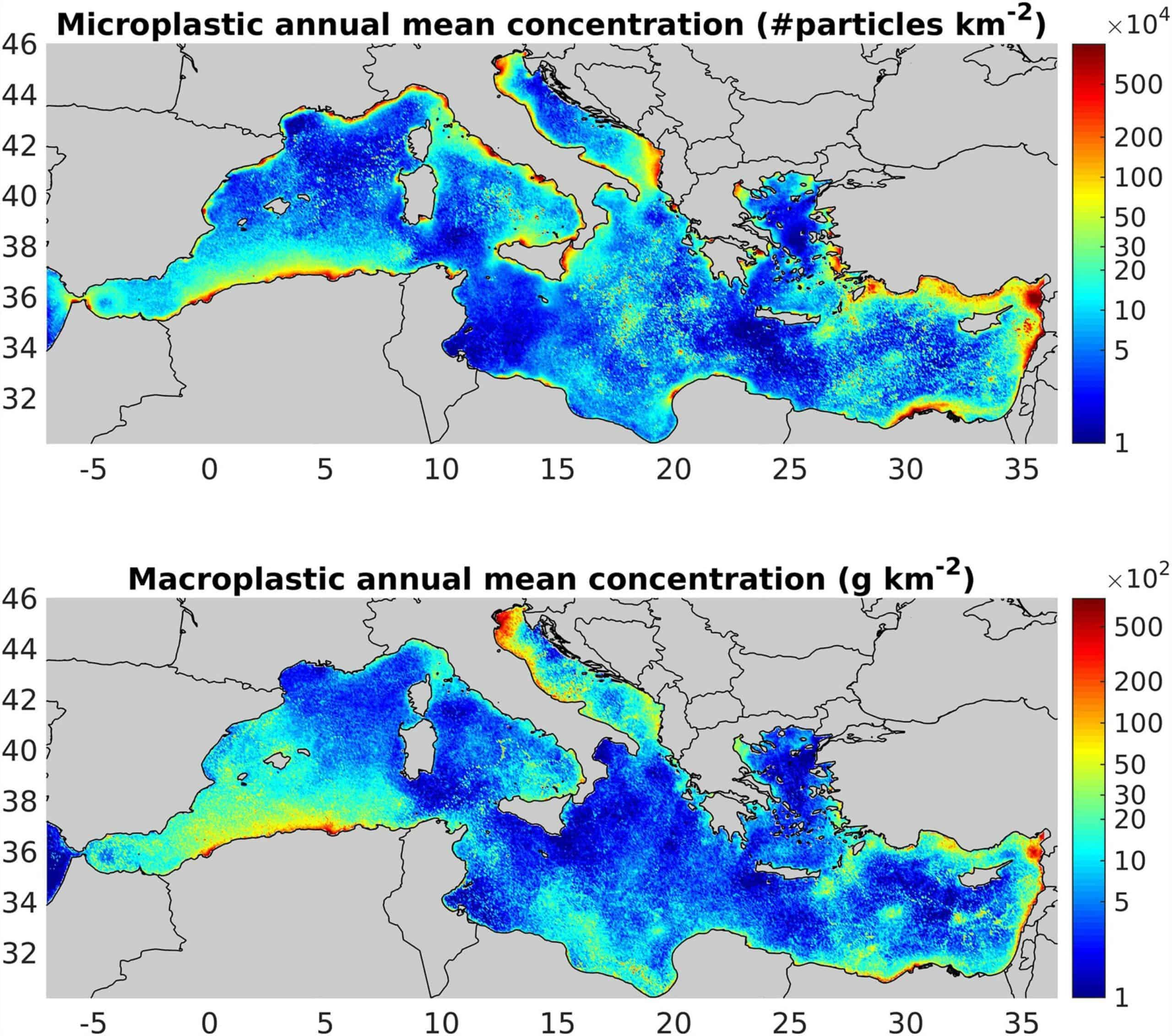
The researchers carried out a three-year simulation (from 2016 to 2018) of the distribution of plastic particles in the Mediterranean Sea. They used a particle drift model that considers the main dispersion processes such as winds and currents, incorporating three land-based sources of plastic particles – wastewater discharge, rivers, and cities.
The findings showed that coastal zones were the hardest hit, both by macroplastics and microplastics (plastic pieces smaller than five millimeters). As MPAs tend to be closer to coastal zones, they accumulated more plastic waste than sites in offshore waters. Most plastics were traced back to land-based sources, which means the issue has to be tackled at source.
Related posts:

FILIPINO SCIENTIST TAKES FIRST EVER JOURNEY TO THIRD DEEPEST OCEAN TRENCH ON EARTH, FINDS PLASTIC
When Dr Deo Florence Onda found himself more than 10,000m below the surface, in the third deepest trench on the planet, he was on the lookout for mysteries hidden in the darkness.

SCIENTISTS STUDYING MICROPLASTICS IN ANTARCTICA DISCOVER… IT ALMOST ALL CAME FROM THEIR SHIP
Scientists studying the origins of microplastics in Antarctica have discovered that 89 per cent of the samples they analysed came from the paint on their own ship.
The average concentration of macroplastics in inshore waters was larger than five kilograms per squared kilometer, while offshore waters had over 1.5 kilograms. Meanwhile, average microplastics concentration in inshore waters was higher than 1.5 million particles per squared kilometer, and 0.5 million particles in offshore waters.
“The most effective way to reduce plastic pollution in protected areas is by reducing marine litter at the sources. A management plan including litter reduction at its sources can occasionally be successfully implemented locally,” the researchers wrote, suggesting the use of a floating barrier installation and a pre-filtering device.
Source:
- Pollution in Delhi hits record high, cloaking city in smog
- Plastic-eating insect discovered in Kenya
- Why air pollution bamboozles pollinating bees
- How Paris Cleaned Up the Seine, and Where to Swim
- Eleven tonnes of rubbish taken off Himalayan peaks
- Plastic munching marine fungus found in Great Pacific Garbage Patch


